Choosing the correct safety harness lanyard length depends on more than the distance a worker needs to reach. The lanyard must provide sufficient movement while keeping the fall distance within the available clearance below the work position. Anchor location, lanyard type, worker movement, energy absorber deployment, and the position of the attachment point all affect the required length.
For most work-at-height applications, the correct approach is to determine the required working range first, identify the available fall clearance, and then select one of the appropriate lanyard lengths and configurations. A longer lanyard is not automatically safer; excessive length can increase potential fall distance and create additional hazards.
What Factors Determine Safety Harness Lanyard Length?
The appropriate harness lanyard length is primarily determined by four factors: the required working reach, anchor position, available clearance, and the type of fall protection system being used.
A worker attached to an anchor directly above the work position may need a relatively short connection because horizontal movement is limited. When the anchor is offset from the worker, additional length may be necessary to reach the work area, but the increased swing-fall potential must also be considered.
The lanyard's construction is equally important. A fixed-length lanyard behaves differently from a self-retracting lifeline, while an energy-absorbing lanyard requires additional clearance for absorber deployment. The selected length therefore needs to be evaluated together with the complete fall protection system rather than as an isolated product dimension.
How Does Anchor Position Affect Lanyard Length?
Anchor position has a direct influence on both usable lanyard length and fall risk.
An overhead anchor generally provides the most favorable geometry because the connection remains close to the worker's centerline. An anchor positioned at or near the worker's working level may require a different connection length or configuration depending on the required movement and work area. An anchor below the worker's attachment point can create particularly demanding clearance conditions and should only be used when the system is specifically designed and approved for that configuration.
Horizontal anchor offset also matters. When a worker moves away from the anchor, the lanyard forms an angle rather than remaining vertical. This can increase swing-fall exposure, potentially causing the worker to travel laterally during a fall.
For this reason, selecting safety harness lanyard length should always account for the actual anchor location, not simply the distance between the harness and the intended work area.
How Much Clearance Is Needed for a Safety Lanyard?
Available clearance must be sufficient to accommodate the total required fall clearance specified for the fall arrest system.
For an energy-absorbing lanyard, the clearance assessment normally considers the length of the lanyard, potential free fall, energy absorber deployment, the worker's body length below the harness attachment point, and an additional safety margin. The exact calculation depends on the specific equipment and applicable fall protection requirements.
For example, a longer lanyard may increase the amount of movement available during normal work, but it can also increase the distance the worker could travel before the fall arrest system becomes fully effective. If the working platform is close to a lower level, using a longer lanyard simply to increase reach may therefore be inappropriate.
The manufacturer's instructions and the applicable local regulations should be used for the final minimum clearance calculation.
What Safety Harness Lanyard Length in Meters Is Suitable?
There is no universal safety harness lanyard length in meters that suits every application. Common fixed lanyard configurations are often available in standardized lengths, but the correct choice depends on the equipment design, anchor arrangement, and required movement.
A practical selection process is:
Determine the maximum distance the worker needs to move from the anchor.
Identify whether the anchor is overhead, at the working level, or otherwise offset.
Calculate the available fall clearance.
Account for the lanyard's energy absorber and other system components.
Select the shortest configuration that provides the required working range without compromising fall protection.
In many applications, choosing the shortest suitable lanyard is preferable because it limits unnecessary slack and potential fall distance.
How Do Different Lanyard Lengths Affect Worker Movement?
Different lanyard lengths create different operating envelopes around the anchor point.
A shorter lanyard restricts the worker's reach but generally keeps the worker closer to the anchor. This can be beneficial where the work area is compact or where clearance below the worker is limited.
A longer lanyard provides greater horizontal reach and may be useful when workers need to access a broader work zone. However, additional slack can increase the potential fall distance and may allow the worker to move farther from the anchor, increasing swing-fall exposure.
The objective should therefore be to match the lanyard's movement range to the actual task. Selecting the longest available option without considering clearance is poor fall-protection practice.
How Should Lanyard Length Be Selected for Different Anchor Positions?
The same lanyard may behave very differently depending on where it is connected.
With an overhead anchor, a shorter connection can often provide sufficient movement while keeping the worker close to the anchor. This configuration generally minimizes lateral displacement during a fall.
With a horizontal anchor at the worker's level, more lanyard length may be required to reach the working position. However, the available clearance and potential swing path should be carefully evaluated.
When the worker must move along a structure, a twin-leg lanyard can provide continuous connection during transitions between approved anchor points. In this situation, the length of each leg, connection geometry, and the design of the complete fall arrest system need to be considered together.
What Are the Key Lanyard Components to Consider?
Length is only one part of a fall protection connection. Other lanyard components can significantly influence performance and clearance requirements.
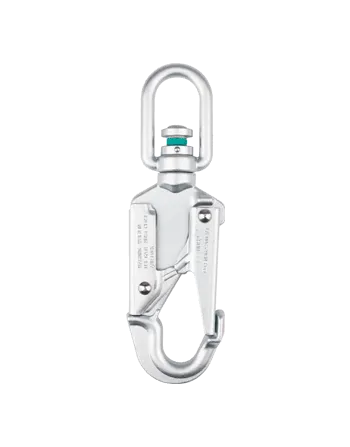
These may include the energy absorber, connectors, hooks, snap hooks, attachment eyes, rope or webbing, adjustment mechanisms, and protective elements. Each component must be compatible with the harness and anchor system.
An energy absorber is particularly important when evaluating clearance because its deployment can add to the overall stopping distance. Connectors also affect the effective connection geometry and must be compatible with the designated harness and anchorage points.
For industrial purchasing, it is therefore better to evaluate the complete lanyard specification rather than compare products solely by length.
How Do You Choose Between Fixed and Adjustable Lanyard Lengths?
A fixed-length lanyard is generally straightforward when the working position and anchor geometry remain consistent. It provides a predictable connection length and can be useful for repetitive tasks.
An adjustable lanyard offers greater flexibility when workers need to operate at different distances from the anchor. Adjustment can help control slack and maintain an appropriate working position, provided the product is designed and certified for that use.
The important consideration is whether the adjustment mechanism can be safely used in the intended fall protection configuration. Workers should not modify the effective length of a lanyard in a way that conflicts with the manufacturer's instructions.
How Can Worker Movement Change the Required Lanyard Length?
Worker movement should be considered in three dimensions rather than simply measured as a straight-line distance.
A worker may move sideways, forward, backward, or around structural obstacles. The required lanyard length must accommodate necessary movement while keeping the worker within the protected work zone.
Moving farther from the anchor can also change the fall trajectory. In particular, horizontal movement away from an anchor can create a swing-fall hazard, where the worker may travel laterally toward a structure or edge after falling.
For mobile work areas, it may be more appropriate to reconsider the anchorage arrangement or use a different type of fall protection system rather than simply increasing harness lanyard length.
What Is the Best Way to Determine the Correct Lanyard Length?
The best method is to start with the work task and anchor geometry rather than with an available product length.
First, define the worker's required operating area. Then identify the approved anchorage point and measure the practical working distance. Next, determine the available clearance and calculate the maximum potential fall distance according to the specific fall arrest equipment.
Only after these factors have been established should the appropriate lanyard configuration be selected.
For manufacturers, distributors, and industrial buyers, this approach also helps prevent a common purchasing mistake: specifying a standard lanyard length without considering how the product will actually be installed and used.
Conclusion
The correct lanyard configuration is the one that provides the required working range while remaining within the fall protection system's specified limits for fall distance and clearance.
Anchor position, worker movement, energy absorber deployment, connection geometry, and the complete set of lanyard components all need to be considered together. Rather than selecting a lanyard based only on nominal length, buyers should evaluate the actual work environment and intended anchorage arrangement before specifying the product.
For industrial applications, a properly matched lanyard can provide the required mobility without introducing unnecessary slack or increasing fall exposure.
FAQs
What is the standard safety harness lanyard length?
There is no single standard length for every application. Common lengths are available, but the correct choice depends on anchor position, clearance, and required movement.
Is a longer safety lanyard safer?
Not necessarily. A longer lanyard can increase working reach but may also increase potential fall distance and swing-fall exposure.
How do I measure safety harness lanyard length?
Measure the effective connection length specified by the manufacturer and evaluate it together with the anchor position, harness attachment point, and required working range.
Does anchor height affect lanyard length?
Yes. Overhead, level, and lower anchor positions create different fall geometries and clearance requirements.
What does safety harness lanyard length in meters mean?
It refers to the nominal length of the lanyard expressed in meters, but the usable fall protection range also depends on its design and connection configuration.
Can an adjustable lanyard replace different fixed lanyard lengths?
In some applications, yes. It can provide greater flexibility, but it must be designed and approved for the intended adjustment and fall protection configuration.
 EN
EN
 fr
fr  de
de  es
es  it
it