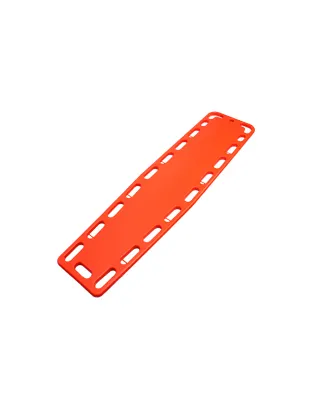
Choosing the correct Rescue Stretcher position helps protect the airway, reduce pain, and prevent secondary injuries during emergency patient transport. Below are the most common Rescue Stretcher positions and when to use them, followed by key safety precautions for stretcher handling.
Supine Position on a Rescue Stretcher
The supine position on a Rescue Stretcher can be used for most severely injured patients. It helps prevent excessive bending of the neck and spine, reducing the risk of vertebral displacement.
For patients with open abdominal wall injuries, shouting or breath-holding may cause intestinal protrusion. Place the patient supine on the Rescue Stretcher with the lower limbs flexed to help reduce abdominal organ protrusion.
Lateral Position on a Rescue Stretcher
After ruling out cervical spine injury, the lateral position on a Rescue Stretcher can be used for patients with altered consciousness. This helps prevent aspiration if the patient vomits.
When positioning laterally on the Rescue Stretcher, place a pillow (or folded clothing) under the neck to maintain a neutral airway and head alignment.
Semi-Sitting Position on a Rescue Stretcher
For patients with isolated chest injuries, severe breathing difficulty may occur due to pain or pneumothorax. If thoracic/lumbar spine injury and shock are excluded, a semi-sitting posture on the Rescue Stretcher may improve ventilation and comfort.
Prone Position on a Rescue Stretcher
Patients with extensive chest wall injury and paradoxical breathing may develop severe hypoxia. In selected cases, prone positioning on a Rescue Stretcher can help compress and limit paradoxical chest movement, supporting more effective breathing.
Sitting Position on a Rescue Stretcher
A sitting position on a Rescue Stretcher may be appropriate for patients with pleural effusion or heart failure, as it can relieve respiratory distress and improve oxygenation.
Rescue Stretcher Transport Precautions
1) Assess Before Moving the Patient Onto the Rescue Stretcher
Before transfer, check vital signs and injury sites—especially head, spine, and chest trauma, with particular attention to possible cervical spine injury. Ensure the airway is clear. For unconscious patients or airway obstruction risk, prioritize the lateral or supine position on the Rescue Stretcher.
Follow standard first aid procedures for bleeding control, bandaging, and immobilization before moving the patient.
2) Prepare Personnel and the Rescue Stretcher Before Lifting
Do not move the patient until rescuers and the Rescue Stretcher are fully ready. For overweight or unconscious patients, coordinate lifting and securing to prevent falls or secondary injury during stretcher transport.
3) Monitor Continuously During Rescue Stretcher Transport
Observe breathing and consciousness throughout transport on the Rescue Stretcher. Keep the patient warm, but avoid covering the head/face too tightly to prevent airway compromise.
If asphyxia, respiratory arrest, or convulsions occur, stop the Rescue Stretcher immediately and perform emergency treatment at once.
4) Use Special Rescue Stretcher Methods in Hazardous Environments
In fire scenes with heavy smoke, move low (bend or crawl) while transporting the patient. In toxic gas leaks, rescuers should cover the mouth/nose with a wet towel or use a gas mask to avoid exposure while handling the Rescue Stretcher.
5) Spinal Injury Immobilization on a Rescue Stretcher (Critical)
For spinal or spinal cord injury patients, place the patient on a hardboard Rescue Stretcher and secure the body using triangular bandages or straps.
For suspected cervical spine injury:
Stabilize the head and neck with sandbags, pillows, or clothing on both sides
Secure the forehead to the Rescue Stretcher with triangular bandages
Wrap and fix the entire body to the Rescue Stretcher to minimize movement
 EN
EN
 fr
fr  de
de  es
es  it
it